Tackling Tough Jobs: Deep Pour Solutions That Perform

Large or deep-fill projects—especially those 10,000 square feet and larger or requiring 2” or more of height correction—often tempt contractors to rely on traditional presanded methods or improvised fill systems to control costs. But these approaches can quickly drive expenses higher than expected. Presanded self-leveling underlayments are costly by volume, extremely heavy to transport, and notoriously slow to mix and place across large footprints. To offset the weight and material cost, many crews turn to pea gravel or foam board as fill layers, hoping to stretch coverage and keep loads within structural limits. Unfortunately, these “cost-saving” methods often introduce new risks: inconsistent performance, increased labor, extended timelines, bonding challenges, and a much higher potential for callbacks. In reality, the hidden costs of presanded systems—and the workarounds they force—can significantly inflate project budgets while compromising long-term flooring performance.
In this blog, we explore traditional methods used for large and deep fill projects and share innovative solutions to save time and money without compromising long-term flooring performance or the structural integrity of buildings.
Pea Gravel Method
Pea gravel (typically 3/8”) is often used in deep fills to raise the surface before the initial underlayment pour. Then an underlayment is mixed into the pea gravel, ensuring the underlayment is fully incorporated and bonds to the substrate beneath it. To accommodate the finished flooring, the mixture application should provide a ½-inch or 3/8-inch allowance from finished height. The next day, the filled surface can be primed.
Drawbacks of Pea Gravel:
- May exceed dead-load restrictions and hinder structural strength
- Settling can compromise the underlayment bond to substrate and create hollow spots or cracking
- Washed pea gravel can add more moisture to leveling mix which can impact compressive strength
- Incompatible pea gravel, such as shale stone, can impede underlayment bond with substrate
- Non-bagged, non-washed pea gravel introduces the risk of bond-breaking contaminants
- Labor-intensive
Foam Board Method
Another traditional method for large and deep fills uses expanded (EPS) or extruded (EXP) polystyrene, commonly known as foam board. EPS board must meet ASTM C-578-85 for Type IV or Type IX with a 25 lb. minimum density. When using foam board, the underlayment must be poured a minimum of 1-inch thick over the top of the EPS board. At thicknesses of 1-inch to less than 1½-inch, the EPS board must have holes drilled in all directions — 1-inch minimum diameter holes (12-inch on center maximum) — to support the pedestals. The EPS board must be securely fastened to the subfloor either with adhesive or an underlayment slurry. Once the EPS board is installed, it can be primed and capped with a Maxxon underlayment, typically the next day.
Drawbacks of EPS Foam Board
- Rigid foam board does not contour with substrate undulations
- Large voids create hollow spots that impact contact with substrate
- Adhesives/slurry mixes may not resolve large gaps between board and substrate, resulting in poor adhesion
- Improper adhesion can lead to underlayment cracking and delamination
- Drilling holes is messy and time-consuming
- Foam board prices continue to increase
Using Presanded Products
Presanded self-leveling underlayments arrive with the sand already blended into the bag, so installers mix each batch onsite using small mixers, barrels, or handheld tools. Water is added, the material is blended to a workable consistency, and crews carry or pour each batch into place. While this method can work on smaller areas, it becomes highly inefficient and risky on large projects that exceed 10,000 square feet.
Drawbacks of Presanded Products:
- Slow production rates: Barrel mixing and hand-pouring cannot keep pace with the volume required for large footprints.
- High labor burden: Big crews are needed to keep up with repetitive mixing, carrying buckets, and placing material.
- Batch-to-batch inconsistency: Thousands of individual mixes increase the risk of uneven water ratios, strength variability, and surface differences.
- Quality control challenges: Without pump-applied consistency, flatness and finish can vary significantly across large spaces.
- Schedule delays: The manual process becomes a bottleneck, often extending timelines compared to pump-applied systems.
- Logistical overload: Managing pallets, water, small tools, and continuous onsite mixing across a large area becomes difficult to coordinate.
- Increased physical strain: Moving heavy buckets across wide floor plates creates fatigue, higher error rates, and potential safety risks.
The Sleeper Dilemma
Another big drawback of traditional methods for large and deep fills is when a sleeper system is present, or the demo process reveals one. Bringing a sleeper system to height can be labor intensive and add extra time and expense when traditional methods are used. Bringing the subfloor to the necessary height can require 3 or more inches of material along with extended installation and curing — all factors that can derail the project timeline and initial estimate.
The Large and Deep Fill Landscape
Many scenarios drive the need for a large and deep fill solution. Renovating old buildings. Converting offices to residential units. Repurposing parking structures into hotel rooms. Even updating gymnasiums with old sleeper systems.
Whether completely adapting a structure’s use, bringing settled buildings up to level, or addressing concrete shrinking and bird baths, Maxxon’s solution for large and deep fills rise above traditional methods — allowing flooring professionals to meet market demands for time and money to seize more project opportunities.
Changing the Game: Maxxon Innovation & Expertise
Maxxon’s solution for large and deep fills combine innovation with five-plus decades of floor prep expertise to simplify the installation process and accelerate project timelines. Regardless of project requirements and conditions, Maxxon equips you to rise to change the game.
Maxxon Commercial Low Density Fill™ (LDF)
For deep-fill applications, especially where weight is a concern, Low Density Fill™ outperforms traditional methods with speed and ease.
- 80% lighter than concrete with a weight of 28 to 32 lbs. pcf
- No thickness limitation, starting from 3/8-inch
- Easy to place and transition
- Can be pumped or poured over electrical conduit and plumbing
- Fast drying, typically overnight
- Cap with 3/4-inch Maxxon underlayment
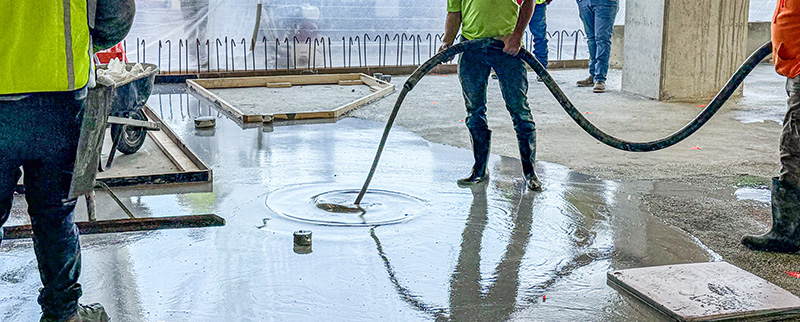
Maxxon Commercial Pro Level-Right®
For capping Low Density Fill™ or providing a high-strength lift to commercial spaces, applicator-applied, Level-Right® is the right, cost-effective choice.
- Compressive strengths from 5,000 – 7,000 psi
- Can be applied from featheredge to 3-inch
- Self-leveling to ¼-inch with great flow properties
- Fast install up to 25,000 sf/day by Maxxon-approved applicators
- No special subfloor prep required
- GreenGuard Gold Certified and UL Fire Rated
Maxxon Commercial Pro Level-Crete™
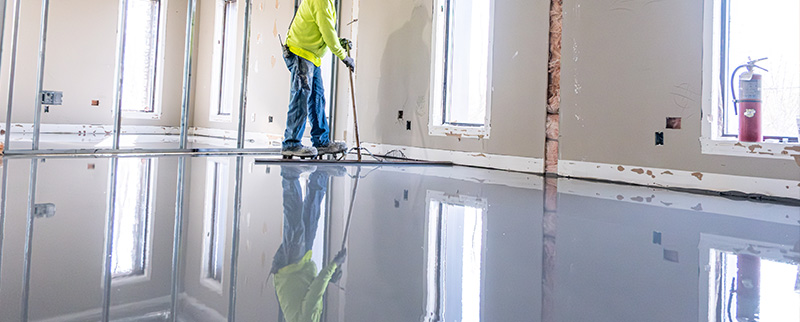
For capping Low Density Fill™ or lifting and leveling commercial spaces, applicator-applied, Level-Crete® is a resurfacing powerhouse at an affordable price.
- Compressive strengths from 4,000 – 5,000 psi
- Great flow properties, can be applied from featheredge to 3-inch
- Meets ASTM F710 standards for preparing concrete to receive resilient flooring
- Eliminates shotblasting to minimize prep
- GreenGuard Gold Certified and UL Fire Rated
Call Before You Fill
For large and deep fill applications, Maxxon’s proven floor preparation products and systems eliminate guesswork, reduce installation time, and ensure consistent performance across every project. With our proven solutions, you’ll complete jobs faster, avoid costly rework, and maintain the reputation that drives your business forward.
If you need help finding our product, or before you estimate your next large and deep fill project, reach out to a Maxxon rep. We’ll provide expert guidance on the best solution to save you time and money while delivering great results. Talk with your Maxxon rep today.