Designing for Fire & Sound: Comparing Board Systems to Acoustic Isolation Systems
NEW DEMANDS IN MULTIFAMILY DESIGN
Over the last few decades, reducing noise transfer in multifamily construction has become an important consideration. Driven by code and occupant demands, sound attenuation is now a significant factor in multifamily design and construction. It increases tenant satisfaction and reduces occupant turnover to improve long-term profitability of multifamily properties.
EDUCATION IS THE power THAT PROTECTS YOUR PROJECTS
Recently, composite board and magnesium oxide (MgO) board products have been marketed as an alternate underlayment solution for multifamily properties. As the leader in fire-safety and sound control for multifamily construction, Maxxon is committed to advancing the industry, not only through innovation, but education as well. As you evaluate specification options, it can be helpful to examine how different systems approach fire performance and acoustic control. Comparing these approaches alongside established, proven solutions and asking a few key questions along the way can help ensure the selected assembly aligns with both design intent and real-world performance expectations.
UNDERSTANDING THE SCIENCE OF MULTIFAMILY FIRE SAFETY
The gypsum component of Maxxon Gyp-Crete products is an effective heat sink. Chemically combined water is released from the Gyp-Crete between 200-300°F, absorbing heat from a fire and slowing its spread. For over 50 years, Maxxon® Gyp-Crete® underlayment has been used in multifamily construction as an effective fire-safety solution and is listed in over 140 fire-rated designs. Composite and MgO board products are not listed in as many UL assemblies, which could make it harder to specify and harder for contractors to substitute. This could mean future delays on the project when adding them into your design.
understanding the SCIENCE OF MULTIFAMILY SOUND CONTROL
Board-based floor systems are usually installed by fastening the panels directly to the structure. While that approach can seem straightforward, it can also create what acoustical engineers refer to as flanking paths, routes that allow sound and vibration to move through the floor-ceiling assembly. Because the boards are rigidly attached to the framing, structure-borne vibration can transfer more easily from one space to another.
Another factor is mass. Composite board panels typically weigh less than gypsum underlayments, and less mass generally means less ability to block airborne sound. In controlled testing comparing composite board systems to gypsum underlayment assemblies, STC ratings were measured up to seven points lower. As a result, board systems may help reduce some higher-frequency sounds, but they often struggle with lower-frequency impact noise, such as footsteps or dropped objects. Therefore, rigid panel systems may require additional layers or treatments to achieve similar performance of an isolated system.
When we talk about an isolated system, we mean that the floor is completely disconnected from the rest of the structure. The Maxxon Acoustic Isolation System includes Maxxon® Acousti-Mat® to create the “floating” floor, which provides an air gap that helps dissipate impact sound; Maxxon Underlayment to create a solid mass that blocks airborne sound transmission; and Maxxon® Acousti-Mat Perimeter Isolation Strips to block a connection between the “floating” floor system and the building structure. The Maxxon Acoustic Isolation System does not use mechanical fasteners. This eliminates the potential for flanking paths which aid in sound transfer.
Additionally, by offering seven Acousti-Mat products, Maxxon offers many options that exceed code requirements to achieve desired levels of acoustical comfort for designers. Simply put, board products don’t offer much for performance customization.
COMPARING THE OPTIONS
As you review the information above, it may be helpful to take a moment to look at the assemblies themselves. Seeing the systems side by side can make the differences clearer. How the layers are built, how the system connects to the structure, and how each approach is designed to manage fire and sound within the floor assembly. These construction details can play an important role in overall performance. See the comparisons below to view the assemblies side by side.

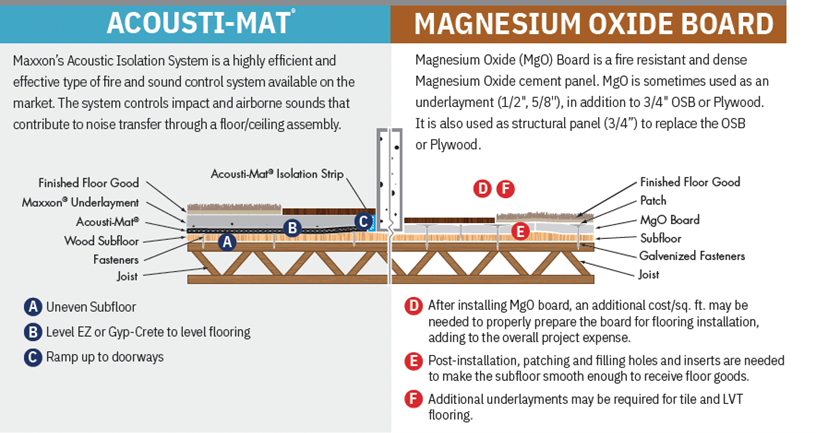
For additional design tools, like 2D or CAD details, see our product information on the CADetails website here.
SIDE-BY-SIDE, MAXXON DELIVERS ABOVE THE BOARD
When carefully reviewing critical details, it’s clear that Maxxon delivers proven and tested, rated reliability that goes above and beyond board claims. Both during the construction process and throughout occupancy and renovations, the Maxxon Acoustic Isolation System remains the superior fire-safety and sound control solution for multifamily construction.
Building professionals seeking proven solutions can access Maxxon’s Fire & Sound Manual which features an extensive list of sound-tested and UL listed assemblies organized by construction type and Maxxon’s Interactive System Selector to identify which assembly featuring Maxxon’s Acoustic Isolation System is the best fit for ensuring a code-compliant and quieter environment for building occupants. Access the links below to get started, or contact your Maxxon rep